 Rugby Rogues
GUIDE RUGBY ROGUES · 6 min
Rugby sevens positions: seven roles explained
A rugby sevens side has three forwards and four backs. Their usual roles help you follow the scrum, the pass and the space outside, even though every player has to attack and defend.
What are the positions in rugby sevens?
Seven players are usually described as three forwards and four backs. The forwards form the three-player scrum: two props and a hooker. The backs typically include a scrum-half and players who organise and use space farther out, often described as a fly-half, centre and wing. These are useful labels, not rigid assignments for every minute of play. World Rugby confirms the three-forward, four-back split and notes that position names may vary by region.
| Players | Group | What to watch |
|---|---|---|
| Two props | Forwards | They bind on either side of the hooker at a scrum, then return to open play. |
| Hooker | Forward | The hooker completes the three-player scrum. |
| Scrum-half | Back | Often links possession won at a set piece to the next pass. |
| Fly-half | Back | Can steer the ball towards the available space. |
| Centre and wing | Backs | Offer wider running options and return to defend. |
Teams can organise their backs differently. The table describes a common shape, not a requirement printed on a shirt.
What do the three forwards do?
At a set scrum, the three forwards bind against three opponents. World Rugby's sevens variation requires three players from each side in that formation. Once the ball is out, forwards can carry, pass, support, tackle and cover space. With only seven people on a full-size pitch, staying near the last set piece would leave a large gap elsewhere.
To identify them, watch a scrum first: the three bound players are the forwards in that phase. Then follow one who breaks away to support the carrier. The role changes with the phase; it does not stop that player from joining the attack.
What do the four backs do?
Backs move the ball and look for running space. A scrum-half and fly-half can connect possession won near the scrum with runners farther out; World Rugby's sevens guide mentions both as links in the team. Wider players offer a passing option and cover the outside when defending. None of this prevents a back from tackling or a forward from scoring.
When watching an attack, look beyond the carrier. A teammate behind or level with the carrier can receive a legal backward pass, then run forward into space. Our sevens basics guide explains why the pass and the following run are separate parts of the move.
Are sevens positions as specialised as in 15s?
The team structure differs: three forwards and four backs in sevens, compared with eight forwards and seven backs in 15s, according to World Rugby. The pitch size does not shrink. Each sevens player therefore has more ground to cover and has to contribute both in possession and without it. World Rugby says positional differences are less pronounced in sevens. Our sevens versus 15s comparison covers the other rule differences.
How can you read the roles during one play?
Ask three questions. Who has the ball? That tells you which side is attacking. Who is close enough to support the carrier? A supporting runner can receive a pass and keep the move alive. Who closes the space without the ball? A defender's position can stop a direct route to the try line. These questions are more useful than relying on a shirt number alone because players change jobs as a move unfolds.
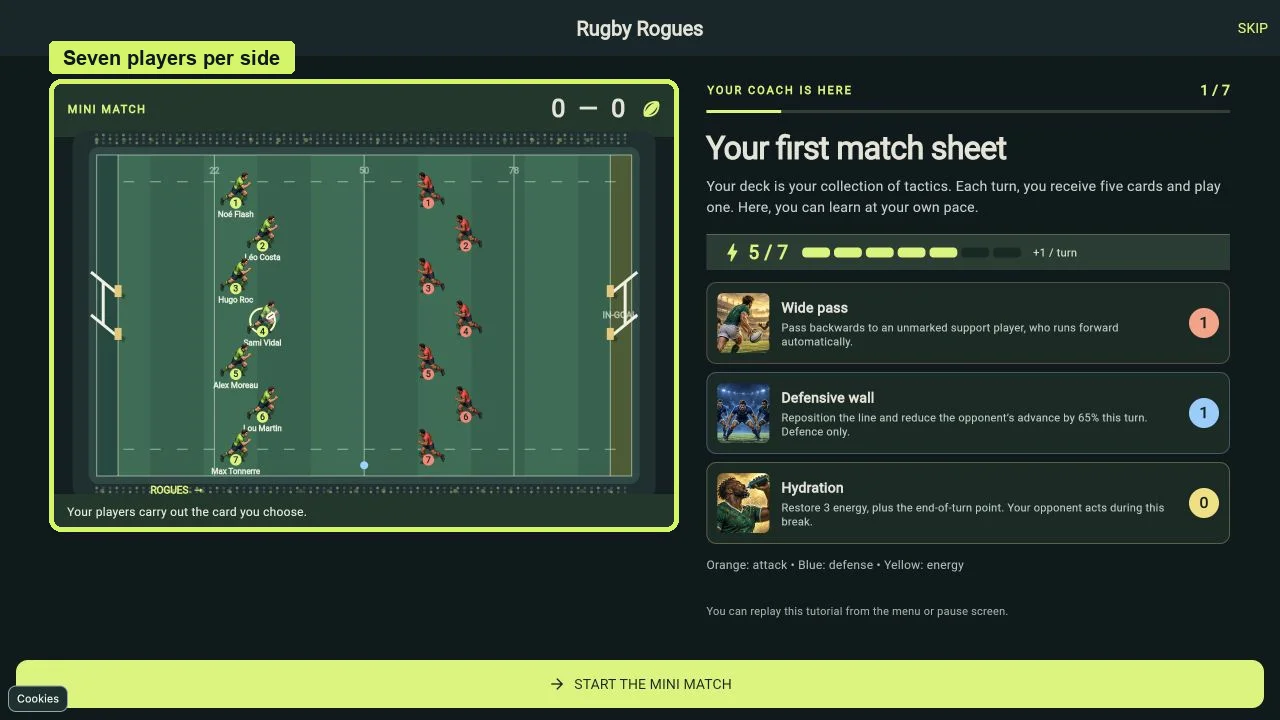
The Rugby Rogues practice match shows seven players per side, a highlighted carrier, a pass to support and a defensive reset. The game uses cards, turns and energy. It illustrates those decisions without reproducing every official position or law.
Quick questions
How many forwards are in rugby sevens?
Three. They form the scrum, then join running, passing, support and defence in open play.
How many backs are there?
Four. A common grouping includes a scrum-half and three other backs; names and positions can vary between teams.
Can a forward score a try?
Yes. A position describes a usual job, not an exclusive right to score.
Can a wing defend infield?
Yes. Players move as the match develops; everyone has to contribute to defence and support.
Remember the essentials
Start with the shape: three forwards, four backs. Then follow the carrier, the nearby support and the defenders closing space. The guided practice match below lets you observe those choices in Rugby Rogues.