 Rugby Rogues
GUIDE RUGBY ROGUES · 5 min
Rugby sevens vs 15s: what changes?
Rugby sevens uses the same size pitch as 15s, with fewer players and much shorter halves. These are the differences that help you read a match.
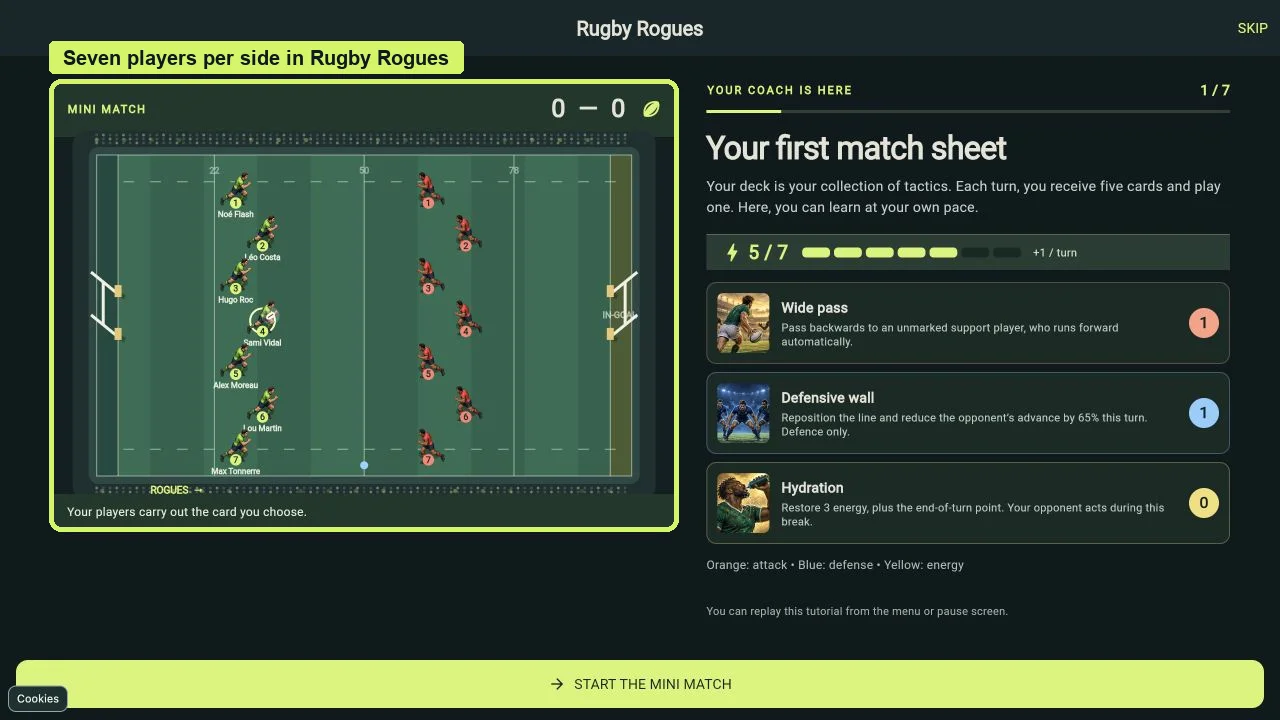
What is the difference between rugby sevens and 15s?
Sevens has seven players per side and two seven-minute halves. Fifteens has fifteen players per side and halves of up to forty minutes. Both use a full-size rugby pitch, score five points for a try and require a hand pass to go backwards. Fewer players covering the same ground make support running and space easier to see.
| Feature | Sevens | Fifteens |
|---|---|---|
| Players on the pitch | 7 per side | 15 per side |
| Ordinary match | 2 × 7 minutes | 2 × up to 40 minutes |
| Set scrum | 3 per side | 8 per side when both teams are complete |
| Conversion kick | Drop kick | Place kick or drop kick |
| Try and conversion | 5 + 2 points | 5 + 2 points |
These figures follow World Rugby's sevens variations and its general time law. Finals and extra time can follow different limits.
Why does the same pitch feel different?
World Rugby confirms that sevens and 15s use the same size pitch. At sevens, each defender has more ground to cover. When a carrier draws a defender, a supporting runner may find an opening; without support, the carrier can become isolated. That is a tactical effect of team size, not a different passing law. Our rugby sevens basics guide shows how to spot the carrier and support on a seven-player pitch.
How do scrums and conversions change?
A sevens scrum has three players from each side. A full 15s scrum has eight. After a try, sevens requires a drop-kick conversion; in 15s, the kicker may also use a place kick. The scoring value stays the same: five for the try, plus two if the conversion succeeds.
How can you tell which format you are watching?
Count the players at kick-off and check the clock. Seven players and two seven-minute halves point to sevens. A three-player scrum and a drop-kick conversion are further clues. In either format, a hand pass must travel backwards even though the receiver can then run forward. The first-match Rugby Rogues guide illustrates that difference with a pass to support.
Does Rugby Rogues use the official sevens laws?
Rugby Rogues takes the seven-player team, backwards passes and try scoring as its inspiration. Its matches use cards, turns and energy, so official match lengths, scrums and kicks are not all reproduced literally. The guided match teaches a pass, defensive positioning and a try. For its own tactical choices, read the beginner strategy guide.
Quick questions
Is the sevens pitch smaller?
No. World Rugby says sevens uses the same size pitch as 15s.
Is a sevens try worth more?
No. A try is worth five points in both formats; a successful conversion adds two.
Can you pass forwards in sevens?
No. A hand pass must go backwards. The receiver can then run towards the opposition's goal line.
Does a sevens final always last 14 minutes?
No. World Rugby allows a final of up to two ten-minute halves, plus time lost and any permitted extra time.
Remember the essentials
Sevens keeps the pitch, the backwards hand pass and the try scoring of 15s. Team size, match length, scrums and conversion method change. Try the guided practice match below to see the seven-player shape in action.